Showing posts with label Gene McArtor. Show all posts

Wednesday, May 8, 2013

SEC Legend: Gene McArtor

Gene McArtor
Former Mizzou Baseball Head Coach Gene McArtor, who never coached in the SEC (for that mater, he never coached in the Big 12), has been selected to be named an SEC Legend:

♦ SEC announces baseball legends (SEC Digital Network)
Featuring former standouts from Southeastern Conference member institutions, the SEC Baseball Legends Presented by AT&T will be honored at the 2013 SEC Baseball Tournament May 21-26 at the Hoover Met in Hoover, Ala.

“The SEC Baseball Legends Presented by AT&T allows us to honor the deep tradition and history of baseball in our league and show why the SEC is the nation’s premier baseball conference,” said SEC Commissioner Mike Slive. “We are grateful to our friends at AT&T for helping to continue to make this program possible.”

The 2013 class features Hal Baird, Auburn; Terry Shumpert, Kentucky; Skip Bertman, LSU; and Gene McArtor, Missouri. Four legends will be recognized each year, with representatives from Ole Miss, Mississippi State, South Carolina and Tennessee set to be honored in 2014. The inaugural class in 2013 included: Dr. Jeffrey Laubenthal, Alabama; Kevin McReynolds, Arkansas; Brad Wilkerson, Florida and Rev. Reggie Andrews, Georgia....

Sunday, September 23, 2012

SEC Fan's Guide to Mizzou Baseball: You Might Be a Long Time MU Baseball Fan if . . .

Simmons Field pre-Taylor Stadium
You might be a long-time Mizzou Baseball fan if . . .
  1. You see jersey number 41 on the field and the first name you think of is first baseman Cody Ehlers, not pitcher John Miles.
  2. You show up for a game at Taylor Stadium with the temperature in the 80s and you layered up and  brought an extra jacket
  3. You saw Tiger Baseball games coached by Gene McArtor.  Extra points if you saw John Hi Simmons coach.
  4. You remember Phil Bradley as a hot-hitting outfielder more than as a league-leading quarterback.
  5. You've ever been nervous walking up the rickety stairs to the old pre-Taylor Stadium press box
  6. You've watched a game from under the grandstand during a rain shower
  7. You have listened to someone other than Tex Little do play-by-play of Tiger Baseball on the radio.
  8. You remember when Pietroburgo was a pitcher who was drafted by the Seattle Mariners, not a catcher who became a Mizzou assistant coach
  9. You were a fan of Big 8 baseball.  Extra points if you were a Big 7 or even Big 6 fan.  
SEC Baseball Fan's Guide to
Mizzou Baseball
You might be a Mizzou Baseball newbie if .. .
  1. You show up at a game when the temperature is in the upper 60s, wearing shorts and a t-shirt, and are surprised how cold it is.
  2. You park in the middle of the main parking lot so you'll be close to the gate, and then come out to see a baseball-sized hole through the windshield.  Of the car next to yours.  You hope.
  3. You ask, "Who's that guy yelling, Let's Go Mizzou!  Let's Go Mizzou!?"
  4. You believe the Event Staff when they tell you the lower section is only for reserved seat season ticket holders
  5. You're surprised when the Event Staff won't let you take in the sodas you stashed in your bag.  And you haven't learned the tricks for getting them in anyway.
  6. The attendance is over 2,000 and you wonder why the crowd is so small.
  7. You don't get excited when the Tigers beat a bad Kansas Jayhawks team.
  8. The numbers 1954, 15, 33 and 34 mean nothing to you.
  9. You're surprised at how much fun you can have at Simmons Field.

Sunday, August 12, 2012

SEC Fan's Guide to Mizzou Baseball: Gene McArtor

Gene McArtor 1961
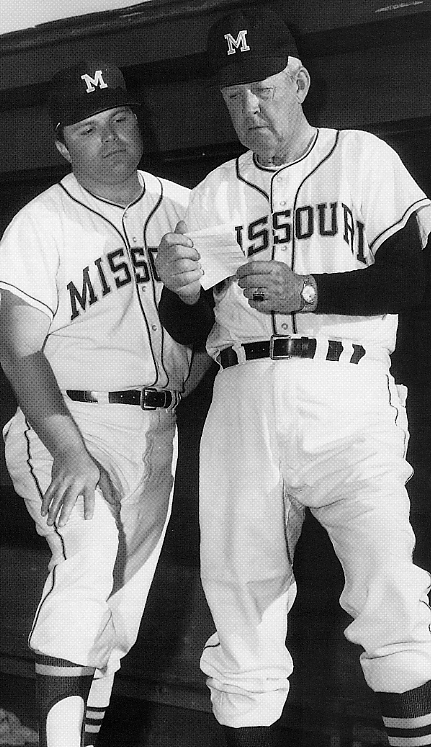
Gene McArtor was a scrappy first baseman for John "Hi" Simmons Tigers from 1961-1964.

After his playing years were finished, he stuck around as an assistant coach to Coach Simmons.  When the legendary Simmons retired after the 1973 season, the task of filling his cleats after 37 years was a daunting one.

Coach Mac took the helm of the Tiger Nine at a time when the playing season was growing and the game was changing.  The 1954 National Champion Tigers played a total of 26 games from the season opener through the championship game of the College World Series.  The record-setting 1964 team played all of 32 games.  McArtor's first team played 42 games (without going into the post-season).  Two years later the Tigers played a 62-game schedule.

The pace of the game and the popularity of the college game were also on the rise.  This was the era when first Ron Polk and then Skip Bertman were dragging the sleepy Southeastern Conference into a new age as a hotbed of college baseball.  Cliff Gustafson had the Longhorns rolling like a juggernaut and Gary Ward was about to turn the Oklahoma State Cowboys into the dominant team in the Big 8.

Gene McArtor and
John "Hi" Simmons
McArtor's Tigers never made it to the College World Series, but they did make appearances in the NCAA Regionals 6 out of his 21 seasons.  They won the Big 8 only three times during a period when the Big was dominated by Gary Ward's Cowboys.

McArtor still holds the record for most wins by a Mizzou Baseball coach, compiling a 733-430-3.  That averages out to about a 35-20 record over the 21 seasons of his career.

He was inducted into the American Baseball Coach's Association Hall of Fame in 1993. He also received the organization's highest honor in 1997, the Lefty Gomez Award. This award is given to an individual who has distinguished himself among his peers and contributed significantly to the game of baseball locally, nationally, and internationally. His number was retired in 1994 and adorns the left field wall at Taylor Stadium.

SEC Baseball Fan's Guide to
Mizzou Baseball
Upon retiring from coaching, McArtor spent several years as a Senior Associate Athletic Director at MU.  He is now the NCAA National Coordinator of Baseball Umpires

♦ Columbia Daily Tribune on McArtor leaving the MU Coaching job, May 8, 1994
Like most MU coaches, McArtor spent most of the '80s trying to compete under a shrinking budget.

``To give in to that means you have no chance,'' he said. ``To just give in and throw up your hands, you have no chance. We tried to make the best of it that we could and in many cases succeeded above the funding level of the program.''

McArtor has had only one losing season. That was in his second year, 1975, when finances were flush in comparison. McArtor played a lot of freshmen that year. The next season, the Tigers won the Big Eight.

McArtor, too, grew into the job. Born and raised in Missouri, he played first base for the Tigers under John ``Hi'' Simmons in the early '60s. After six years of teaching and coaching at St. Louis-area high schools, he returned to MU to achieve a Ph.D in education and assist Simmons. Their combined tenure goes back to 1937.

``I had a clear-cut goal out there in front of me, and that was probably Enos Semore at the University of Oklahoma, who'd won a number of Big Eight Conference championships in a row,'' McArtor said.

``Oklahoma had a very, very successful program within the conference. And along with that, they had five or six key players that were from the state of Missouri. Some out of St. Louis, some out of Springfield.

``So when I took over, that was the goal that we were shooting for. We had to keep Missouri players in Missouri, and Oklahoma was the team that we were trying to catch.''

McArtor played on two College World Series teams but has not made it back as a coach, although six of his teams have made the NCAA playoffs.

Wednesday, June 27, 2012

Mizzou Baseball 1979: Big 8 Champions

Coach Gene McArtor

Tom Heckman
Phil Bradley
MU Pitcher Ron Mathis

MU Pitcher Steve Southerland
Photos from Savitar and from MU Baseball Media Guides

4 Days

Monday, April 2, 2012

Mizzou Baseball History: 1962

■ McArtor Hits for Cycle (Columbia Missourian, April 3, 1962)
Gene McArtor
A stocky six-footer stole a term from poker yesterday when he hit a "full house" in the 15-7 defeat of Arkansas at the Missouri baseball diamond

Gene McArtor, who hit .276 last season, led off with a double, then followed with a triple, a single and a homer in four trips to the plate. The veteran player, who took over first base mid-season last year, grounded out in his last trip to the plate.

In last Thursday's double header with Arkansas State, McArtor was 4 for 6, including two triples. This brings his total to 8 for 11 in three games or a .727 average.

McArtor said he couldn't remember doing this in college ball. He had, however, hit similarly when playing American Legion ball in Maplewood, MO.

Looking at the performance with a coach's caution, John "Hi" Simmons said McArtor's hitting is not necessarily a true test of what he will do for the season.

"Batting averages have a way of fluctuating," Simmons said. "Balls that he is hitting now may fall and be caught later in the season.

"I am pleased with his performance so far, though."

■ Tigers Whip Arkansas, Stay Unbeaten in Baseball (The Maneater, April 4, 1962)
Missouri's got a winner in baseball. Or at least, the Tigers' early seson play indicates this.

Coach John (Hi) Simmons; diamond squad continued on its merry, undefeated way here yesterday afternoon by defeating southern neighbor Arkansas 10-4.
. . .

The Black and Gold were never in serious trouble in its contest yesterday with the Porkers. Larry Bohannon, a righthander from Sikeston, picked up the victory by hurling the first four frames for the Simmons' crew. Righthander Bobby Jenkins fired the last five innings for Missouri, striking out five batters in the process. Lefthander Ted Mont was the losing moundsman for Arkansas.

First baseman Gene McArtor, a stockily built leftie who swings a bat with the accuracy that a logger swings an axe, belted three hits in five trips to the plate to pace the Tigers offense. All told, Missouri whacked 13 safeties yesterday.

Saturday, June 18, 2011

Mizzou @ the College World Series

■ Former MU Head Coach Gene McArtor, always a straight-shooter, was in the news at the College World Series today.
Florida beats Texas 8-4 in CWS (Sports Illustrated)
Johnson appeared to be robbed of a home run in the seventh after his two-out hit off Nathan Thornill bounced back onto the field after appearing to strike the railing above the yellow line atop the wall in right center. Umpires kept him at second base after conferring.

After the game, NCAA umpire coordinator Gene McArtor issued a statement acknowledging that the hit should have been ruled a home run.

Wednesday, April 1, 2009

MU 19, SLU 6

■ Missouri pounds SLU at Busch Stadium, according to the Columbia Missourian:
“It’s a couple steps forward and one step back. Overall, we are moving in the right direction, but the middle of the game was kind of sloppy," Missouri coach Tim Jamieson said.

After scoring only four runs in three games against Oklahoma State this weekend, the Tigers scored 19 runs on 16 hits.

Coming into the game shortstop Michael Liberto was struggling at the plate and during batting practice, the coaches were telling him to stay behind the ball.
"I was like, 'What the heck does that mean?'" Liberto said.

■ The St. Louis Post-Dispatch took notice for the second day in a row, with Mizzou routs SLU at Busch Stadium:
"I'm hoping maybe tonight is the catalyst, get fired up playing here," coach Tim Jamieson said before the game. "It's all confidence."

The game served a dual purpose. The St. Louis Cardinals got a chance to work out any stadium kinks five days before their season opener on Monday against the Pittsburgh Pirates, except with 2,117 fans instead of a sellout. Coaches from both schools are interested in making this an annual event.
■ RockMNation comments on last night's game and indulges in some worry:
Mizzou hit and scored at will, but on a worrisome note, Kyle Gibson once again got smoked, giving up three runs in his lone inning on the hill. After being untouchable for most of the season, Gibson has now given up 10 earned runs in his last 3 innings. We'll see what happens this weekend against OU. There's pretty much no way Mizzou can get hot enough to make the NCAA tourney if Gibson struggles for any lengthy amount of time
■ Johnny Wholestaff's hair took on a bit of a carrot-top tinge last night as Kyle Gibson pitched the first inning in a 10-pitcher game. Nick Tepesch got an inning as well, making Johnny a true Wholestaff representative.

Mr. Wholestaff's updated stats for the season: 7-1, 2.41 ERA, 71 IP, 60 H, 24 R, 19 ER, 18 BB, 53 SO. One stat stands out as a key to the success so far: JW has given an average of only 2.25 walks per game.

■ MU's game with OU on Saturday will broadcast live on Fox Sports Midwest. Familiar Mizzou voices will be at the mikes: Chris Gervino for play-by-play, with former Coach Gene McArtor doing color commentary.

■ RockChalkTalk.com has an optimistic analysis of Kansas Baseball during the Coatch Ritch Price era:

Tuesday, February 10, 2009

2009 NCAA Baseball Rules Changes

■ Former Tiger coach Gene McArtor is now the NCAA Coordinator for Umpires. In that role, he has narrated a video detailing changes in the NCAA Baseball Rules for 2009 (the video runs about 20 minutes) . The 2009 Rulebook is also online in PDF format, and the first few pages detail these changes in print. Changes include:

· Positioning of base coaches
· Base coaches must wear helmets while on the field
· A coach leaving the dugout or their position to argue balls and strikes may be ejected without warning
· Specifications about personal confrontation and physical abuse of umpires
· Umpires will be emphasizing checking the proper location of the batter's box and the marking of the coaches' box
· Players shall not leave the dugout for home run celebrations or any other purpose while the ball is live
· Unsportsmanlike activities in the dugout will be penalized
· Umpires will emphasize the rule that a batter must not leave the batter's box during an at-bat, and will enforce the limit of 20 seconds between pitches
· Walk-up music must stop when the PA announcer announces the next batter or when the batter reaches the dirt cut-out surrounding home plate

Tuesday, June 10, 2008

Gene McArtor named NCAA National Coordinator for Baseball

The NCAA has announced that Gene McArtor, who spent over 40 years at the University of Missouri as a student-athlete, coach and administrator, has been named NCAA National Coordinator for Baseball Umpires. McArtor replaces Dave Yeast who resigned in February.

As national coordinator, Gene will assist the Division I Baseball Committee with the selection and evaluation of officials for the Division I championship. He will also work with officials, as well as conference coordinators and regional advisors of officiating, coaches and NCAA staff, to help provide clear and consistent interpretations of NCAA men’s baseball rules and officiating mechanics. In doing so, he will work in conjunction with NCAA Baseball Secretary-Rules Editor Jim Paronto and other individuals with umpire mechanics expertise.

“The national coordinator plays a critical role in ensuring we have the very best umpires for the Division I baseball championship. We are fortunate to have someone of Gene’s quality serving in this leadership role,” said Larry Templeton, athletics director at Mississippi State University and chair of the NCAA Division I Baseball Committee.

McArtor has a long history with the NCAA. He was named chair of the NCAA Baseball Committee in 1987, directing the championships in Division I and coordinating the selection of the 48 Division I schools for the championship and College World Series (CWS). He also was the committee chair during a five-year tenure that saw unprecedented growth of the championship, including national television coverage, bracket expansion and stadium renovation. In addition to his committee experience, McArtor also spent 30 years officiating high school and college football games that included numerous years of playoff and championship game experience.
McArtor has been a member of the executive committee and board of directors for the American Baseball Coaches Association. In 1987, he was elected fourth vice president of the organization and rotated through the vice president chairs to the presidency in 1991. He is also a member of the ABCA Hall of Fame.

McArtor stepped into athletics administration at Missouri later in his career, first taking the position of associate athletics director and then senior associate athletics director in 1997. He then moved to director of project management and also served a stint as MU’s interim director of athletics.

As head coach, McArtor guided six teams to the NCAA Tournament, coached 13 All-Americans and 41 all-conference players, and guided 55 players to the professional ranks during his tenure. During his 21 years as head coach, he compiled a 733-430-3 record and became the winningest coach at Mizzou when he recorded his 482nd win in April 1987. He won Big Eight championships in 1976 and 1980, including three-consecutive Big Eight Eastern Division crowns under the old divisional format. The Tigers also claimed four regular season conference championships, with McArtor twice earning Big Eight Coach of the Year honors. He led Missouri to a school record 46 wins in the 1976 season and remains the winningest coach in MU baseball history. McArtor earned his bachelor’s, master’s and Ph.D degrees at Missouri.

“We’ve seen significant progress in umpiring over the years, and much of that can be attributed to Dave Yeast’s leadership and individuals who love the sport and are willing to accept change for the betterment of the sport,” said McArtor. “I look forward to the opportunity to continue the growth and build on the successes we’ve witnessed, which helps our umpires and provides a great experience for student-athletes and coaches.”

Sunday, April 27, 2003

Phil Bradley's #15 Retired


“I’ve seen him play both football and baseball, and I think that baseball may be his best sport, if I might be so presumptuous.”

~ MU Baseball Coach Gene McArtor, March 1979


On April 27, 2003, Phil Bradley's Number 15 joined two other retired numbers affixed permanently to the outfield walls of Simmons Field. The other two belong to a pair of men who coached the Tigers over the span of 58 years, from 1937 through 1994: John "Hi" Simmons and Gene McArtor.

Bradley, who played in the outfield for the Mizzou baseball team during the 1979, 1980 and 1981 seasons, was the first non-coach to see his number retired by Missouri.

No one who was following MU athletics in the late 70's and early 80's has to ask why Phil Bradley deserves such an honor. For those of you who are newer to the Mizzou family, I offer the following statistics, profiles, internet links and reproductions of news articles from the Columbia Daily Tribune.

Number 15 takes place among MU legends (Columbia Tribune, 4/28/2003)


MU's McArtor can't hide optimism
(From the Columbia Daily Tribune, March 1, 1979)

When Missouri baseball coach Gene McArtor insists that he’s “excited” about his team’s chances this season, the obvious response is to find the good man an icepack and gently lead him to a soft bed in the corner where nobody will bother him.

After all, the Tigers open the season today at Oral Roberts without three-time All-American shortstop Greg Cypret, first baseman Curt Brown, the team’s leading hitter last season at .371 and four of Missouri;s most reliable pitchers.

Sure coach, whatever you say.
.....
The outfield exemplifies the Tigers’ conversion to speed this season. The most encouraging addition to the team is Phil Bradley, who probably will become the regular left fielder.

Bradley, the electrifying all-Big Eight quarterback, was forced to participate in spring football practice as a freshman. This time, he’s in no apparent hurry to flop on shoulder pads.

The situation with Phil,” McArtor says, “is that he will remain with the baseball team as long as he is playing. And right now, I’ll guarantee that he’ll be playing.”

“I’ve seen him play both football and baseball,” he continues, “ and I think that baseball may be his best sport, if I might be so presumptuous.”


Standing at a Crossroads
Baseball or football? Missouri's Phil Bradley must soon decide
(From the Columbia Daily Tribune, May 4, 1980)

Phil Bradley stands at life's crossroads, pondering one of those decisions that shapes a future. His is a choice of opportunities, not of reluctant remedies. But nonetheless, it's a dilemma - and one that Philip Poole Bradley, age 21, Macomb, Ill, must decide for himself.

The gifted young athlete at the University of Missouri has a decision to make this summer. A decision infinitely more important than choosing to keep the football himself instead of handing off to James Wilder, much more permanent than deciding to throw a 5-yard pass across the middle to Andy Gibler instead of a long strike to Ken Blair.

This decision has to do with football and baseball, two careers for which Bradley carefully has groomed himself. His decision also has to do with completing a college education now or taking the chance of finishing those final semesters later. And in this game, you don't get to punt if your first three decisions are wrong.

In this zany world of college baseball, athletes are eligible for the professional draft after their junior year in college or once they turn 21. So Bradley can be chosen by a Major League organization this summer. Furthermore, not only is Missouri's standout center fielder eligible to be drafted in June, he also is a desirable commodity in the baseball business.

At the same time, though, Bradley has rewritten the passing and rushing records for quarterbacks the past three seasons at the University of Missouri. And even more is expected from the two-time all-Big Eight Conference quarterback this season.

But it seems certain that Bradley will be chosen in the baseball draft in June, before his senior year begins this fall at Missouri. One scout already has said, much to the chagrin of the football coaches, that Bradley is certain to be drafted.

First and foremost, Phil Bradley must please Phil Bradley.

"I've got a feeling what I'm going to do, but I'm not going to let it be known publicly," Bradley says. "The less I say, the less I stir everybody up."

It was a mere "maybe" after the Missouri Tigers' 34-14 win over South Carolina in the Hall of Fame Bowl back in December that did "stir up" this situation.

In the locker room after the game, Bradley, dressed in a three-piece suit and shining his Most Valuable Player trophy with a white handkerchief, said to a group of reporters, "I've got to go. See you guys next year...maybe."

Maybe?

Stories were written. Implications were made. Questions were asked of Missouri football coach Warren Powers that he didn't particularly appreciate. A few tempers flared.

Bradley has been taking care of himself just fine during this baseball season, only his second in college. After participating in spring football practice his freshman year, Bradley called to Powers' attention the promise former Missouri Coach Al Onofrio had made when Bradley signed his scholarship. Onofrio had agreed to let Bradley skip spring football practice his sophomore year and play baseball instead.

During his first season with Missouri, Bradley hit .314, led the team in triples (five), hit five home runs and earned second-team all-Big Eight honors in right field.

This season Badley was moved to center field and into the leadoff position in the batting order. And until the last month, he was a hot item at the plate. Going in to a double-header with Oklahoma in early April, Bradley was batting .382.

But since then, he has been in a prolonged slump, prompting McArtor to move him to seventh in the Tigers' batting order. In one stretch, Bradley had only two hits in 10 games and in another stretch he went hitless in four consecutive games. His average entering yesterday's double-header with Iowa State stood at .317.

But the slump won't make the professional scouts shy away. The talent is still there.

"I'm not a very good projector of talent," Bradley says. "I don't know how well I can do at another level. But the only way for me to find out is to get a chance to see."

One pro scout said of Bradley, even befoer the season began, that he definitely had the speed and arm to play professionally. The only question, he said, was Bradley's bat.

McArtor, who has seen several of his players sign professional contracts, says Bradley "has the qualities professional ball clubs look for - arm strength, running speed, good athlete. And what is important from a professional standpoint, is you've got to like to go out and play every day. Phil is one of those guys you sit out for a rest, and wants to get in there and play.

"But it's all projecting talent. A lot of guys never get drafted because they aren't projected as big league ball players. You see, there are things that can't be taught in the game of baseball. A guy has to have speed - it's either there or not. Phil's got it. A guy has to have arm strength - it's there or it's not. And he has that, too. He has to have raw talent."

Another variable Bradley has to consider is the degree he is pursuing in business. Should Bradley decide to go the professional baseball route, he would be forced to complete his degree in the off-season.

"The degree - it falls into line with everything else," Bradley says. "The degree depends on whether I'm here or not. If not, then when do I get the chance to go back?"

Considering Bradley's family background, a college degree would seem quite important to him. Bradley's parents are both college graduates. His father, Dr, William Bradley, is a professor in the Physical Education Department at Western Illinois University in Macomb. His older brother, Rey, who played both football and baseball at Virginia Sate, also is a college graduate.

"He comes out of a family where his mother is a college graduate, his father is a college graduate, and conversations have been around college athletics and college education," says the senior Bradley. "Many times we've had analysis types of discussions. Not if people win or lose, but analyze people and their performances.

"I'm sure this has had an influence on all our kids. Especially Phil."

Phil Bradley's theory of football in the fall and baseball in the spring is not totally unfounded. "In out household, we went with the seasons, says William Bradley." "It's my professional opinion, I think athletes specialize too soon. The more chances they get to run, jump, do those athletic skills more, the greater chance they have of reaching their optimum level of skill."

In a way, McArtor finds the whole situation a little amusing. For years now, the Missouri baseball team has been
raided by professional clubs drafting players after their junior years. There weren't many people concerned about that.

But now that the football program stands to lose a player to professional baseball, fans are aghast.

"It will be interesting," McArtor says with a devious smile. "To us, this is no different than 50 other guys we've had that have signed in the past. Maybe we're just more used to it by now. It just doesn't do us any good to get upset when the guys sign early."


Missouri savors crown - especially Bradley
(from the Columbia Daily Tribune, May 15, 1980)

Last night, after Missouri had defeated Nebraska, 5-3, to win its second Big Eight baseball championship in five years of the post-season tournament, the Tigers milled around and celebrated their fourth consecutive win.
Phil Bradley, who was voted the tournament's Most Valuable Player, was in rare form.

Bradley, who doubles as a quarterback in the off-season, was beside himself with joy. You didn't need to ask the usually reserved Bradley a question to receive an answer this night. The words and emotions flowed freely from the junior like never before.

"Unbelievable," said Bradley, wearing a smile stretching from here to Tulsa. "I've been playing athletics for I don't know how many years and I've been so close to winning championships and now I've finally got one. I have finally won something, and it is in the Big Eight, and I even had a good tournament.

"This is the most enjoyable tournament I've ever had. The most enjoyable five games, and I got a chance to do what I do best. Get on base. Run. Score runs. And take chances."

Bradley did those thins se well he was the clear-cut winner in the voting of the media members for the Most Valuable Player award and for one of three all-tournament outfield spots. Bradley finished the five games with a not-so-impressive .266 average - four for 15 - but the Missouri centerfielder coaxed nine walks and scored a tournament high eight runs.

Bradley's mere presence on the basepbaths seemed to produce mistakes by Nebraska, Oklahoma State and Oklahoma. And with the ever-present possibility of Bradley stealing, opposing pitchers gave designated hitter Shane Fairbanks, who batted behind Bradley, a lot of inviting pitches to hit. Fairbanks, who also made the all-tournament team, led the Tigers with a .417 tournament batting average.

"I was on base twice, scored twice and somebody noticed," Bradley said. "This is just great. Just great."
"Ever since the OU game (Sunday), I told Scotty (Collins), You've got to believe...got to believe. And we finally got it all. And we did it the hard way. Wow."

"You know, I'm not trying to rub it in, but all these teams are my biggest nemeses I have in football," Bradley said. "I haven't beaten them, except for Nebraska once. I've lost to Oklahoma and Oklahoma State twice. It's like a personal vendetta against them.

"And we sent them all home. All of them. It seemed they all had parties set for when they won this thing. When we got here, Coach McArtor said it would be a shame if we spoiled all their parties."

And now the Tigers can have one of their own.


Overlooked Bradley does his talking with his bat
(From the Columbia Daily Tribune, April 30, 1981)

In the short span of 10 minutes early last evening, Phil Bradley was a smorgasbord of emotions. When the subject was football, you could see the hurt, anger and disappointment lurking within this 22-ear-old athlete. But when the talk turned to baseball, there was contentment, even a smile or two flashing by.

His frustrations were the result of the National Football League's draft of college seniors. After all, during his four-year career as a quarterback at the university of Missouri, Bradley became the all-time total offense leader in the Big Eight and was selected the all-conference quarterback three times. Twice, he won an honorable mention on the Associated Press' All-America team.

But when the last player in the NFL draft was taken yesterday - about the time Bradley, the center fielder, stepped to the plate for his first at-bat in an afternoon double-header - he was left out in the cold. Nobody drafted him - not as a quarterback, not as a wide receiver, not as a defensive back, not even as simply a gifted athlete.

And, in his own private way, Bradley was mad. Not raging mad, but simmering. More than anything else, his pride was hurt, and Phil Bradley has a heap of pride in himself and whatever he does.

"I mean, there are 12 rounds," he said, "and what, 332 guys get picked? You figure somewhere along the line somebody...even if I was the 332nd picked that would have been all right.

"But that's life."

So yesterday, Bradley let his bat do his talking. And his performance in Missouri's 15-2, 14-2 double-header sweep over the St. Louis Billikens was enough to change his mood.

Here is what the 400 or so persons at Simmons Field heard yesterday afternoon:

In eight trips to the plate, Bradley, in succession, tripled, doubled, walked, homered, singled, singled, walked, and walked. He now has successfully reached base 15 consecutive times.

Bradley scored eight of the Missouri 29 runs, bringing his season total to 60. That's more runs scored than any other Missouri player has hits.

While going officially 5-for-5 yesterday, Bradley drove in six runs and now has 33 RBI for the season, third on the club while batting in the No. 2 spot.

After his perfect day - at the plate, that is - it was Bradley's batting average that perhaps spoke the loudest about his future. Forty seven games into the season, Bradley is hitting .472, with 68 hits in 144 at-bats.

The future, his statistics say, is in baseball. And, perhaps, that's why the football scouts looked elsewhere this weekend for some talent.

"I wouldn't be surprised if that was the reason, " Bradley said. "That's why I didn't get drafted last year in baseball. The baseball people were worried about me wanting to play my last year of football. Now the football people are worrying bout me playing baseball."

"I just wish people would quit worrying about what I might do."

Bradley's disappointment in the NFL draft yesterday was aggravated by the fact that no less than17 quarterbacks were selceted by the 28 professional teams. Some had scrapbooks nowhere as thick as the pile of press clippings Bradley could have collected.

There is always baseball, which Bradley says is his first love.

"He'll be drafted, I'm sure of that," said St. Louis Cardinal manager Whitey Herzog, who watched Bradley go 4-for-5 in an exhibition against his team last week. "He has a good body. How high he goes, I don't know. His arm will get even better once he gets away from football. He's got speed, and he hits the ball."

Since the third game of the Kansas series April 20 - including the exhibition game with the Cardinals - Bradley has 11 hits in his last 13 at-bats.

"The guy started out hot and just hasn't cooled off," said Missouri Coach Gene McArtor after his eighth-ranked Tigers upped their record yesterday to 36-12. "If anyone had seen him today, they just had to be impressed. It was another typical, but very good performance.

"It's gotten to the point now where I don't know if we can expect him to stay as hot as he has been. But his confidence has to be up, and if we continue to hit well as a team, it sure will help him."

"I'm not worrying about my average anymore," Bradley said. :If I simply hit the ball consistently hard, my share of hits will come. Plus, now, my average is not going to go up or down a whole lot."

Bradley welcomed the 1-1/2 week layoff Missouri has had from baseball, and now he's ready for the Tigers' final two road series of the Big Eight conference season.

"I got the rest I needed, and hopefully, now I'm ready for the stretch," Bradley said. "And, hopefully, today is a sign of what's to come."

Then Bradley afforded himself an emotional side-dish, a two-scoop smile on this day of disappointment. He knows the major league draft is June 8


Bradley flies quietly into the sunset
(Columbia Daily Tribune, June 19, 1981)

Think back. Remember those wintry days last December, when Phil Bradley was preparing for the final snap of his much celebrated football career as a Saturday afternoon hero at the university of Missouri.

At the time, you may recall, the world was his. He had everything figured out, although he kept most of his figuring imprisoned from the outside elements. "I've got a plan," he would say confidently, "but I'm not telling, just yet."

A career in the National Football League must have been included in the course he had charted. After all, he was a three-time All Big Eight Conference quarterback, and had gained more yards than any other athlete in Big Eight history. And if not the NFL, then there was always the Canadian Football League. His two-dimensional talents - running and passing - seemed tailor made for the game north of the border.

Another main artery in the Bradley master plan involved baseball. He had the speed and the arm. All he needed to do was swing the bat with some authority in the spring for Missouri - he did to the tune of a .457 batting average - and baseball would provide yet another professional opportunity.

Aboce all else, you must remember the words of Philip Poole Bradley, age 22, of Macomb, Ill, back in those wintry days.

"All I want is a chance. I don't ever want to have to say, Well if I had the chance...I'd rather be able to say I had the chance and I couldn't do it.

"People treat me sometimes as if I came here boasting and bragging that I could do it. I never did that. I came here quietly, and that is the way I want to leave...quietly."

In the end, Bradley had his own way. He received that coveted chance. And he left very, very quietly.
Bradley was not among the 300 or so players selected in the NFL draft. The British Columbia Lions, who had the signing rights to him in the CFL, never showed much interest in him.

And when the Seattle Mariners made Bradley the first selection in the third round of the baseball draft, providing him with that "chance", there was little fanfare. Headlines did not scream; bulletins did not interrupt. It passed very quietly indeed.

So before anyone really knew, the young man with all those glittering alternatives was in a hotel in some town called Bellingham, Washington - not to be confused with Billings, Montana - watching the rain fall.

Well, is Phil Bradley happy?

"Oh yeah," he said, with enough zest to send a smile over those next-best-thing-to-being-there long distance lines. "All I ever wanted was a chance. Now, I've got one. If I don't make it, I don't make it. I'll do something else."

"I thought baseball was in my best interest. I was pretty much thinking baseball. They were showing more interest in me."

If he hadn't come to terms with Seattle, his plans were to work in the summer, return to school in the fall to complete a three-hour course which stands between him and a degree in business, and await the January baseball free agent draft.

"Or maybe I might have waited to play again in the spring," Bradley said, referring to the one year of baseball eligibility he had left at Missouri. "Then, too, I was thinking, maybe football next year. I'd see what happened in January. If nothing, then I'd try out for football as a free agent in the spring."

"As far as where I ended up, " Bradley said, "I didn't know. I ran into some snags along the way, even to get out here. But that is all behind me now, all I've got to do is go out and play."

Opening day for Bradley's chance at professional baseball is set for Tuesday in Eugene, Oregon. Count on it being a quiet debut. Just the way he'd want it.


The quiet man
Phil Bradley's performance, like his silence, is still golden
(Columbia Daily Tribune, June 6, 1983)

If anyone was born to let performance do his talking, Phil Bradley may be that person. Bradley's words come about as often as rain delays in Seattle's Kingdome.

Yet his actions, first as a record-setting quarterback at Missouri and now as a center fielder for the Seattle Mariners, speak volumes.

Did you know Bradley, who still lives in Columbia with his wife, is a big hit with the local charities? Or that he has a degree in personnel management? Probably not. That's the way Bradley prefers it. That's likely the way it will always be.

"He's quiet," Mariners manager Del Crandall says, "but I don't think he's remote or anything like that. He has a nice personality."

On subjects he's enthusiastic about, or talking to someone he's familiar with, Bradley is articulate, witty and downright charming.

Intruders get a cold stare.

Teammates and close followers of the Mariners describe Bradley as reticent, shy, moody and withdrawn.

Several long-time Bradley watchers chuckle and shake their heads. "Same old Phil," they say.

Maybe. But there's also another tag that goes along with being the "Same old Phil" - one that allows Bradley to be everything else. That is, above all, Phil Bradley is a winner. He doesn't understand those who aren't, he ahs no toleration for people who emphasize the negative. Perhaps that's an outgrowth of his days at Missouri when he believes he was unjustly criticized for the Tigers' shortcomings.

He doesn't like to delve into the past. The past, Bradley say, is just that. The future is the future. What's important is the present, which doesn't mean thinking about what might have been had he chosen football over baseball.

"I haven't played football since 1980," says Bradley. "This is 1984 and people are always asking about football. That doesn't make any sense. I'm in the big leagues now. If people can't realize now that I'm a professional baseball player, they probably won't ever realize it."

Seattle's opponents haven't had any trouble realizing it. Bradley, who has had two hits in each of the first two games of a four-game series against the Kansas City Royals, is hitting over .280 in 43 games this season, with eight RBI and on game-winning hit, which came on opening day against Toronto.

"Right now, I'm just getting back into playing every day," he says. "Early in the season I was playing every day, and sometime between then and now I wasn't playing very much."

Between then and now, Dave Henderson was the center fielder. Although his batting average is only .202 with one home run, Henderson is considered more of a power threat than Bradley, who has yet to hit his first major-league homer.

Henderson also has a stronger arm, but Bradley has more range and speed. He's stolen six bases this season, second-best on the slow-afoot Mariners.

"I think he's a good ballplayer," Royals' designated hitter Hal McRae says. "Eventually they may move someone and let both of them play."

"You just try to be ready when your turn is called," Bradley says. "That's all. You don't necessarily know when it's going to be, but when your time comes, you have to be ready to play."

Bradley's time came during spring training. If it hadn't, those close to him say, football was a possibility. But Bradley made it impossible for the Mariners to drop him when he hit .371 with 12 RBI, one home run and three triples.

"When we went down there, we didn't know what was going to happen with him," says Crandall, who avoids the word "platoon" when referring to Bradley and Henderson.

"He's playing pretty well right now, so he'll continue to play," Crandall says. "He's hitting the ball and doing the right things on the field that help you win."

Which is all Bradley has ever done.

"Let's go out there and play," he says.

Further talk isn't necessary.


From the Seattle Mariners' Timeline:

1985
Led by Manager Chuck Cottier, who was brought aboard in September of 1984, the Mariners landed 74 wins for the second straight year. Phil Bradley led the club with a .300 average and was named to the All-Star team.

1986
The club struggled through three managerial changes, moving from Cottier to Marty Martinez, until finally settling on Dick Williams in May. Seattle finished with a 67-95 record and placed outfielder Phil Bradley in the All-Star game


Rocket's Red Glare

The date: April 29, 1986.
The site: Fenway Park in Boston.

It’s the ninth inning, and 23- year-old Red Sox righthander Roger Clemens has just frozen Seattle’s Phil Bradley to notch his 20th strikeout of the game. It’s a new major league record for strikeouts in a nine-inning game, breaking the modern day 19-K mark originally set by Steve Carlton in 1969.

A painting of this moment in history is available (and can be seen) at the above link.


from Baseball Immortals

Single Season Runs Created Leaders 80s

1985
#13
Phil Bradley
116 Runs Created

1987
Tied #14
Phil Bradley
115 Runs Created

Single Season Runs Leaders 80s

1985
Tied #20
Phil Bradley
100 Runs

1987
Tied #17
Phil Bradley
101 Runs

You Could Look it up...SeattlePI.com

First Mariner to have 5 hits in a game:
Phil Bradley
on June 8, 1985

First Mariners Walk-off-Grand Slam:
April 13, 1985
against Minnesota
(17th in MLB history)

First Mariners' All-Star Game Starter:
Phil Bradley,
left field, 1985.