Video by Ashley Arp

Saturday, September 8, 2012

Friday, September 7, 2012

Thursday, September 6, 2012
SxSE: Mississippi State Baseball 1885-2012
The Mississippi State bulldogs have seen good success over the years. They are currently an NCAA Regional program. They can be expected to have a good shot at reaching the Regionals each year, and may go even farther. But there have been enough season in the past decade when they did not get into the tournament at all that they still have something to prove in terms of being a highly successful program. The Bulldogs' average record over the past 10 seasons has been 34-26.
Mississippi State has the oldest tradition in the SEC of participating in inter-collegiate baseball, stretching back to 1885.
C.R. "Dudy" Noble coached the Bulldogs from 1920 to 1927. He went on to be the long time athletic director at Mississippi State. The Bulldogs baseball stadium is named after him.
Paul Gregory coached the bulldogs from 1957 through 1974, compiling a record of 328-161-1 and taking them to the College World Series once.
Ron Polk was the head coach from 1976 through 2008.
♦ History of MSU Baseball (ForWhomTheBellTolls.com) provides a quick overview of the storied history of Mississippi State Baseball. I'll stipulate the writer knows what he's talking about, despite having spelled the current head coach's name incorrectly. For more MSU Baseball History, take a gander at the many old time photos at Glimpses of the Past: Mississippi State Baseball
♦ A big part of MSU Baseball history and tradition is tied to the tenure of legendary head coach Ron Polk. He built Bulldog Baseball - and SEC Baseball - into a powerhouse. For more on Ron Polk, read our post from last year's SEC Dixienary: P is for Polk
Mississippi State Baseball in 2012
The 2012 Bulldogs finished 40-24 overall, 16-14 in the SEC. They won the SEC Tournament and t hen went 1-2 in the Tallahassee Regional.
♦ All Things Considered, it was a Good Year for MSU Baseball (Maroon and White Nation)
♦ MSU Baseball- Don’t Close That Coffin Yet! (Maroon and White Nation)
C.R. "Dudy" Noble coached the Bulldogs from 1920 to 1927. He went on to be the long time athletic director at Mississippi State. The Bulldogs baseball stadium is named after him.
Paul Gregory coached the bulldogs from 1957 through 1974, compiling a record of 328-161-1 and taking them to the College World Series once.
Ron Polk was the head coach from 1976 through 2008.
- Former MU assistant coach John Cohen has been the head coach at MSU since 2009.
- MSU has won the SEC regular season championship 16 times, in 1909, 1911, 1918, 1921, 1922, 1924, 1948, 1949, 1965, 1966, 1970, 1971, 1979, 1985, 1987, and 1989
- MSU has won the SEC Tournament 7 times, in 1979, 1985, 1987, 1990, 2001, 2005, and 2012
- MSU hs been in the NCAA Tournament 32 times, in 1949, 1953, 1965, 1966, 1970, 1971, 1978, 1979, 1981, 1983, 1984, 1985, 1987, 1988, 1989, 1990, 1991, 1992, 1993, 1996, 1997, 1998, 1999, 2000, 2001, 2003, 2004, 2005, 2006, 2007, 2011, and 2012
- MSU has been to the College World Series 8 times, in 1971, 1979, 1981, 1985, 1990, 1997, 1998, and 2007. They have never won the national championship
♦ History of MSU Baseball (ForWhomTheBellTolls.com) provides a quick overview of the storied history of Mississippi State Baseball. I'll stipulate the writer knows what he's talking about, despite having spelled the current head coach's name incorrectly. For more MSU Baseball History, take a gander at the many old time photos at Glimpses of the Past: Mississippi State Baseball
♦ A big part of MSU Baseball history and tradition is tied to the tenure of legendary head coach Ron Polk. He built Bulldog Baseball - and SEC Baseball - into a powerhouse. For more on Ron Polk, read our post from last year's SEC Dixienary: P is for Polk
Mississippi State Baseball in 2012
The 2012 Bulldogs finished 40-24 overall, 16-14 in the SEC. They won the SEC Tournament and t hen went 1-2 in the Tallahassee Regional.
♦ All Things Considered, it was a Good Year for MSU Baseball (Maroon and White Nation)
Pitching was the obvious strength for this team…and they exceeded expectations. Caleb Reed wasn’t as dominate as in 2011, but he was still effective this year with a 2.47 ERA. Chris Stratton surpassed everyone’s expectations by going from a long-relief guy to one of the best starting pitchers in the country.
. . .
The hitting, as we all know, struggled. But consider how much was lost from last year’s team:11 of the top 12 hitters from 2011 either left or missed significant time due to injury this year (Parks, Vickerson, Bradford, Shepherd, Freeman, Brownlee, Norris, Ogden, Collins, Thigpen and Johnson). A guy who hit in the heart of the lineup all year, Hunter Renfroe, only had 26 at-bats in 2011, and hit .154. A lot of young players gained valuable experience this year: Wes Rea, Matthew Britton, Hunter Renfroe, DeMarcus Henderson and Tyler Fullerton. . .
♦ MSU Baseball- Don’t Close That Coffin Yet! (Maroon and White Nation)
That was part of the challenge that John Cohen took on four years ago when he took over. It’s one thing to say that you have to add talent- but there are some things that are deeper than that- things that must be done in order to get the talent that you need to compete for championships. No matter how good the bar-b-que is, no one wants to play for a loser. We had to get confidence back from the players and the fans, we had to makeover our image as a program that simply has a good history, and we had to change the overall attitude of our program. To me, that is the legacy of this team. This is the team that I have been waiting for, for four years that I feel put us back on the map, and gives us a real opportunity to move our baseball program even further forward. And while we didn’t make it to Omaha or even a Super Regional like last year’s team, I think this team accomplished us getting our swagger back. . .
Tuesday, September 4, 2012
SxSE: Coach John Cohen's Mississippi State Bulldogs
♦ Mississippi State Head Coach John Cohen began his career as an assistant coach at Missouri from 1992-1997. He was the chief assistant coach for his final three seasons and served as the Tigers' hitting instructor and recruiting coordinator.
In 1996, Missouri won the Big Eight championship and advanced to an NCAA Regional for the first time in 16 years. The Tigers broke nine offensive school records that season, part of 17 total records set by Cohen's offenses in his six years (from bestbaseballswing.com)
After five seaons as head coach at Kentucky (where he took the historically cellar-dwelling Wildcats to an SEC championship in 2006), Cohen was named to replace legendary MSU Head Coach Ron Polk in 2008. Polk threw a huge hissy-fit, but apparently there was no lasting enmity between the two.
♦ From SEBaseball.com, 3/20/12: John Cohen says what he thinks and doesn't really care who hears it. The Mississippi State skipper has a solid club this Spring and has his squad fighting through a tough rash of injuries.
. . .
After all of the injury challenges, Mississippi State had their chances in Friday's opener as starter Chris Stratton struck out 17 LSU batters but the Tigers won 3-2 in 10 innings.
After the game a fired up Cohen had this doozy of a sound-bite: "We out-competed LSU. We out-worked LSU. We just had some things not go our way at the end."
Quotes like those fire up fanbases on both sides. Writers love to hear it because stories containing them are more likely to be read. That said, you sure don't hear a lot of "we out-whatevered" the opponent quotes these days.
I'm sure many coaches feel like they whipped their opponent everywhere but the run column. Few say it publicly. Part of me likes the bravado. Part of me thinks you should take the high road with comments about other teams - especially after they just beat you.
♦ John Cohen sums up his non-philosophical hitting philosophy in No Philosophy, just Precision (bestbaseballswing.com)
There's a lot of hitting philosophy out there. Precision is what gets the job done, though. Let's take a look at the battle between a pitcher and a hitter to illustrate this point. A pitcher is trying to load up his energy and deliver it to a precise target. The hitter is trying to do the same thing - load up his energy and release it right back up the middle. The pitcher's job is to disrupt the hitters flow of energy with either pitch placement or by changing speeds. Take a curve ball - the curve ball reaches its apex and most hitters will follow the pitch up and their flow of energy is up instead of straight back toward the pitcher. Have you ever seen a hitter miss underneath a curve ball? Hardly, they miss above it and the pitcher has accomplished his goal of disrupting the hitters energy. Philosophy says stay back to hit the curve ball. Precision says work beneath the plane of the breaking ball.
♦ I think the coaching staff has really done a great job building a strong foundation there. I like that the staff was patient and built around high-upside high school kids, even though they knew there would be some risk that it might take those players a year or two to develop. But they have been rewarded for that approach with one of the deepest pitching staffs in college baseball, which has led to the team’s recent resurgence. (Jim Callis, quoted in ClarionLedger.com)
♦ JohnCohenBaseball.com has several articles about Cohen's coaching methods, as well as DVDs available (for a price)
Monday, September 3, 2012
Missouri Baseball in the Majors: Max Newhouser
♦ Max Scherzer stiffs White Sox, puts Tigers within game of first place (Detroit Free Press)
Max Scherzer pitched like Hal Newhouser and moved the Tigers within a game of first place.♦ Prince Fielder, Max Scherzer named top player, pitcher for Detroit Tigers for month of August (mlive.com)
Scherzer blanked Chicago on four hits over eight innings for a 5-1 win in front of a Comerica Park sellout Saturday night. If the Tigers can sweep tonight with Justin Verlander starting, they'll move into a tie for the Central Division lead with the White Sox.
Scherzer struck out nine. He has now fanned at least eight hitters in nine straight starts. That matches Newhouser, the Hall of Famer, for the longest such streak by a Tiger since at least 1918, according to Baseball-Reference.com.
Newhouser had his streak in 1946, when he won 26 games and came close to winning his third straight AL MVP award.
Prince Fielder and Max Scherzer have been named the team's Player of the Month and Pitcher of the Month for the month of August, the team announced Sunday.
. . .
Scherzer went 4-0 with a 2.25 ERA and 44 strikeouts in five starts in August. Scherzer got off to a bit of a slow start, but he is 9-1 in his past 12 starts and leads the American League in strikeouts (204) and the Tigers in victories (15).
Sunday, September 2, 2012
SEC Fan's Guide to Mizzou Baseball: Pitcher U
Over the past decade Tim Jamieson's Missouri Tigers have earned the nickname of Pitcher U. In part this is because of a succession of MU pitchers who were first round draft picks from 2006 to 2009 - Max Scherzer, Aaron Crow (two years in a row), and Kyle Gibson.
Scherzer (Detroit Tigers) and Crow (Kansas City Royals) are both in the major leagues now, and doing quite well. Gibson will soon be heading to the Arizona Fall League as the next step in his rehab after Tommy John surgery. He has been working his way back up the Twins' minor league ladder and could be on the major league roster at some point in 2013.
But the seeds for Pitcher U go farther back than Max Scherzer.
After a dry spell around the turn of the millenium, Jamieson and his staff began bringing in some promising recruiting classes.
Garrett Broshuis was a redshirt freshman in 2001, then improved steadily toward filling the role of staff ace in his final year. Broshuis went on to a pretty good minor league career and is also a good writer.
Justin James came in for the 2002 season, one of a group of young pitchers from Oklahoma and Arkansas who all knew each other and decided to all go to the same college and make a splash together. That group included James and Travis Wendte and Derek Roper, all of whom went on to be drafted. Wendte returned to MU as a graduate assistant coach after his minor league career.
Justin James was drafted after his sophomore year (he was 21) and went on to a journeyman minor league career that looked to be ending in the independent leagues. Until the Oakland A's organization got interested and signed him from the Kansas City T-Bones in mid June of 2010 and had him in the Oakland bullpen by September.
Danny Hill came to the Tigers from the state of Texas in 2003 and immediately became a leader. Hill went on to a short minor league career.
It was the Tigers' success at recruiting and developing pitchers who went on to be drafted that attracted a young - and very wild - Max Scherzer to join the Tigers in 2004.
Scherzer went on to be a #1 draft pick and now is with the Detroit Tigers. Culp was a 4th round pick by the Padres organization. He finally hung up the spikes after the 2010 season.
By now the Tiger recruiting strategy was clear. Every recruiting class should have at least one high level pitching prospect who has a shot a being a top draft pick after three years in black and gold. With the string of successes on display, young pitchers were enticed.
A young pitcher from southwest Missouri, Scott Elbert, signed a letter of intent to play at Missouri when Scherzer and Culp were still freshmen at MU. Elbert became the first of a short list of top recruits to jump to the pros before his MU career ever began, drafted by the Dodgers. He finally made it to the show with the Dodgers in May of 2011.
In 2005 the Tigers picked up Doug Mathis, a JuCo transfer, to flesh out their starting rotation. Mathis was drafted in 2005 and has become a journeyman, traveling through the minor leagues (and Korea), getting his first call up to the big leagues with the Rangers in 2008, and then continuing to see time in Triple-A and the big leagues with various organizations. He had a good season with the Pawtucket Red Sox, Boston's AAA team in 2012 before leaving to play baseball in Japan.
In 2006 a pair of freshman pitchers were up and down with their success in the bullpen and strating rotation for Missouri. But in the 2006 Malibu Regional, freshmen Rick Zagone and Aaron Crow pitched back-to-back gems to keep the Tigers alive and send them on to the Regional final the next day.
Both Zagone and Crow were drafted in 2008. Zagone was drafted in the 6th round that year and is still laboring in the Orioles' farm system, demonstrating he can be a really good High-A pitcher, but an inconsistent AA pitcher.
Aaron Crow was drafted in the first round in 2008 by the Washington Nationals. That deal was never made, though, so he was drafted again in the first round in 2009 by his favorite team, the Kansas City Royals. He made his debut in the KC bullpen in 2011 and found himself at the All-Star game that same season.
Because of Crow's re-entry in the 2009 draft, Mizzou had two pitchers picked in the first round that year, as Kyle Gibson, who was the next top pitcher to enroll at Pitcher U for the 2006-2007 season, also got the nod that year. Gibson is currently rehabbing from Tommy John surgery and is now pitching in rehab in the Twins' minor league organization.
The 2010 draft saw Nick Tepesch taken in the 10th round by the Rangers organization. He is at AA Frisco now, and about as hot as a prospect gets.
In more recent years the Tigers have developed and sent on to the minor leagues such pitchers as Phil McCormick (09-11), Matt Stites (11) and Blake Holovach (12).
And the pipeline is still producing winners. Eric Anderson arrived in 2010 and has been slowed by injuries but is still expected to be a future draft pick if he can get past the injury problems. Rob Zastryzny arrived in 2011 and is expected to be the staff ace in 2013 (and will likely be drafted quite high in June).
This past year's freshman class included a trio of pitchers who have the potential to develop into the hot draft prospects of 2014 in Brett Graves, John Miles and Brandon Platts.
And the incoming class this fall includes pitchers Alec Rash (2nd round draft pick of the Phillies this past June) and Ryan Phillips, both highly touted pitching prospects looking toward the 2015 draft.
Over this "Pitcher U" decade, the Tigers have lost their share of top pitching recruits to the draft. Jarred Cosart jumped from high school to the Phillies in 2008; Jason Adams chose the Royals over Mizzou in 2010, and 2012 saw top recruit Hunter Haynes also jump to the Royals.
♦ Three former Mizzou pitchers excel as pros (yardbarker.com, April 2011)
Scherzer (Detroit Tigers) and Crow (Kansas City Royals) are both in the major leagues now, and doing quite well. Gibson will soon be heading to the Arizona Fall League as the next step in his rehab after Tommy John surgery. He has been working his way back up the Twins' minor league ladder and could be on the major league roster at some point in 2013.
But the seeds for Pitcher U go farther back than Max Scherzer.
After a dry spell around the turn of the millenium, Jamieson and his staff began bringing in some promising recruiting classes.
Garrett Broshuis was a redshirt freshman in 2001, then improved steadily toward filling the role of staff ace in his final year. Broshuis went on to a pretty good minor league career and is also a good writer.
Justin James came in for the 2002 season, one of a group of young pitchers from Oklahoma and Arkansas who all knew each other and decided to all go to the same college and make a splash together. That group included James and Travis Wendte and Derek Roper, all of whom went on to be drafted. Wendte returned to MU as a graduate assistant coach after his minor league career.
Justin James was drafted after his sophomore year (he was 21) and went on to a journeyman minor league career that looked to be ending in the independent leagues. Until the Oakland A's organization got interested and signed him from the Kansas City T-Bones in mid June of 2010 and had him in the Oakland bullpen by September.
Danny Hill came to the Tigers from the state of Texas in 2003 and immediately became a leader. Hill went on to a short minor league career.
 |
| Max Scherzer, flamingo |
The thrill of the gas was so exhilarating, so necessary to his success that Max Scherzer as a high school pitcher would reach peak mph on his fastball only as his mechanics flew apart in a berserk jumble. Forsaking economy for power and balance for speed, Scherzer "touched 90" but did so with a wicked flourish:Along with Scherzer from 2004-2006 was left-hander Nathan Culp. Ususally in Max's shadow as the #2 guy, there were many times during those three seasons that Culp was the go-to guy in the weekend rotation.
Whiplash.
"I used to have the worst head jerk, my hat would fly off sometimes," said Scherzer, the Parkway Central grad who is the All-America ace for the University of Missouri's nationally ranked baseball team. "That's how violent I was. It was violent, real violent. I was so raw."
Working with Tigers coach Tim Jamieson, Scherzer refined his delivery. In drills, he toed the rubber like a flamingo, steadying himself on his push-off leg and bending down to pluck baseballs off the mound. He closed his eyes, repeated the flamingo. He found a mental signpost and repeated it: Chin over toe. Chin over toe.
Balance was the goal.
Firing 99 mph when it mattered most was the result. (St. Louis Post Disaptch)
Scherzer went on to be a #1 draft pick and now is with the Detroit Tigers. Culp was a 4th round pick by the Padres organization. He finally hung up the spikes after the 2010 season.
By now the Tiger recruiting strategy was clear. Every recruiting class should have at least one high level pitching prospect who has a shot a being a top draft pick after three years in black and gold. With the string of successes on display, young pitchers were enticed.
A young pitcher from southwest Missouri, Scott Elbert, signed a letter of intent to play at Missouri when Scherzer and Culp were still freshmen at MU. Elbert became the first of a short list of top recruits to jump to the pros before his MU career ever began, drafted by the Dodgers. He finally made it to the show with the Dodgers in May of 2011.
 |
| Doug Mathis, PawSox mlb.com phot |
In 2006 a pair of freshman pitchers were up and down with their success in the bullpen and strating rotation for Missouri. But in the 2006 Malibu Regional, freshmen Rick Zagone and Aaron Crow pitched back-to-back gems to keep the Tigers alive and send them on to the Regional final the next day.
Both Zagone and Crow were drafted in 2008. Zagone was drafted in the 6th round that year and is still laboring in the Orioles' farm system, demonstrating he can be a really good High-A pitcher, but an inconsistent AA pitcher.
Aaron Crow was drafted in the first round in 2008 by the Washington Nationals. That deal was never made, though, so he was drafted again in the first round in 2009 by his favorite team, the Kansas City Royals. He made his debut in the KC bullpen in 2011 and found himself at the All-Star game that same season.
Because of Crow's re-entry in the 2009 draft, Mizzou had two pitchers picked in the first round that year, as Kyle Gibson, who was the next top pitcher to enroll at Pitcher U for the 2006-2007 season, also got the nod that year. Gibson is currently rehabbing from Tommy John surgery and is now pitching in rehab in the Twins' minor league organization.
The 2010 draft saw Nick Tepesch taken in the 10th round by the Rangers organization. He is at AA Frisco now, and about as hot as a prospect gets.
In more recent years the Tigers have developed and sent on to the minor leagues such pitchers as Phil McCormick (09-11), Matt Stites (11) and Blake Holovach (12).
And the pipeline is still producing winners. Eric Anderson arrived in 2010 and has been slowed by injuries but is still expected to be a future draft pick if he can get past the injury problems. Rob Zastryzny arrived in 2011 and is expected to be the staff ace in 2013 (and will likely be drafted quite high in June).
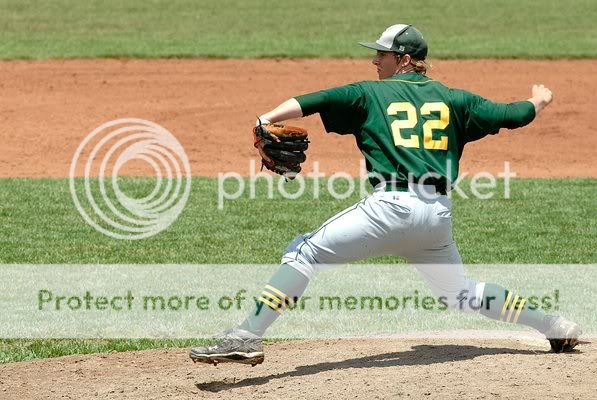 |
| Ryan Phillips, Draft Class of 2015 komu.com photo |
And the incoming class this fall includes pitchers Alec Rash (2nd round draft pick of the Phillies this past June) and Ryan Phillips, both highly touted pitching prospects looking toward the 2015 draft.
Over this "Pitcher U" decade, the Tigers have lost their share of top pitching recruits to the draft. Jarred Cosart jumped from high school to the Phillies in 2008; Jason Adams chose the Royals over Mizzou in 2010, and 2012 saw top recruit Hunter Haynes also jump to the Royals.
♦ Three former Mizzou pitchers excel as pros (yardbarker.com, April 2011)
Vitello recalled a moment after Crow's freshman season when Crow said he was going to be better than Scherzer. At first, Vitello was taken back. Crow had won one game in 13 starts. By the end of that season, Scherzer had solidified his legacy as one of the best pitchers in program history. Vitello laughed, because he knew how much Crow admired Scherzer.♦ Missouri's Gibson comes into his won (Rivals.com, March 2009)
Still, the moment made Vitello think. The scene was an insight into Crow's drive. Was he confident? Sure. A little cocky? Perhaps. But he was bold enough to set a standard. He refused to wilt in Scherzer's shadow. Crow defined a destination. And, with Gibson's help, he spent the rest of his Missouri career trying to reach it.
"I'll be danged if Aaron wasn't every bit as good as Max, as it relates to performance, for us by the time he got out of there," Vitello said.
Scherzer, Crow and Gibson are gone. Their footprints in Missouri's program remain. Rob Zastryzny, a freshman pitcher from Corpus Christi, Texas, researched Missouri's development during his recruitment. What he learned helped him choose the Tigers.
Will he continue Missouri's pitching lineage? How long does a legacy last? When does the flame of a former era fade? Answers might lie in his future.
"It's a huge honor to be able to pitch in the same stadium as those guys," Zastryzny said. "That's part of the reason I came here. Just the talented pitchers that have come through here and been developed here. It's definitely motivation. I want to be just like all of them."
You'd almost think that Missouri coach Tim Jamieson was a modern day Nostradamus.
Jamieson isn't a philosopher and you probably won't see him formulate too many prophecies. But boy does he have an uncanny ability to find talented pitchers and turn them into premier collegiate players.
Max Scherzer, then Aaron Crow and now Kyle Gibson.
Gibson, like Scherzer, Crow, Justin James and Danny Hill, took time to develop into a great hurler.
Gibson was an extremely lanky high school senior considering going to school at Missouri and Jamieson thought the right-hander had the ability to be great.
It just took a little patience for Jamieson to be proved right. Gibson showed promise as a sophomore last season. But this season he finally has taken his game to another level.
Jamieson is not surprised.
"He has made slow progressions, but each year he has gotten better," Jamieson told Rivals.com. "He was better than Max and Kyle as a freshman and hasn't gotten a lot better simply because he already was good. But now, he strikes me as a pitcher that certainly is more polished and confident."
Saturday, September 1, 2012
Friday, August 31, 2012
Missouri Baseball in the Minors: Pre-September Shuffles
♦ James Hudelson was promoted from the Bristol White Sox to the Winston-Salem Dash (Class A Advanced) of the Chicago White Sox organization.
♦ Rick Zagone was moved from the Bowie Baysox to the AAA Norfolk Tides on August 26th
♦ Blake Holovach was moved from the Pulaski Meriners to the Short Season A Everett AquaSox
♦ Eric Garcia was sent back up to the Danville Braves from the GCL Braves.
♦ Rick Zagone was moved from the Bowie Baysox to the AAA Norfolk Tides on August 26th
♦ Blake Holovach was moved from the Pulaski Meriners to the Short Season A Everett AquaSox
♦ Eric Garcia was sent back up to the Danville Braves from the GCL Braves.
Thursday, August 30, 2012
SxSE: Hail State
♦ Dudy Noble Field, Polk-Dement Stadium:
♦ Bulldog fans ring cowbells during games at Dudy Noble Field (and at other Bulldogs sports events). They're apparently not supposed to, according to SEC noise-maker rules, but they do anyway. It's tradition. It's been a huge debate between MSU and the SEC. A big deal. There's even a website called RespectTheBell.com
♦ Sources: Fences at Dudy Noble Will Be Moved In (Maroon and White Nation)
♦ Take Me Out to the Ballpark, John Grisham's ode to Mississippi State baseball.
. . .
"I really loved last year's recruiting class, and I fully expect this program to remain among the top half of the SEC," said Aaron Fitt, who covers college baseball for Baseball America. "But I don't think they will ever return to their dominance of the 1980s - I don't think any program will be able to sustain that kind of consistent top-of-the-SEC performance in today's SEC, which is just so much deeper and more competitive."(Clarion Ledger)
♦ Dudy Gras is an annual parade and celebration signifying the start of Mississippi State University's baseball season. Read about the 2012 Dudy Gras HERE. And read more details about the event in a write-up about the 2011 Dudy Gras.
♦ MSU's student organization, "The Dudes":
- Opened: 1967, at its present location; frequent remodeling and upgrades since
- Capacity: Approximately 7,200, although the all-time record crowd is listed as 14,991
- Named after: Former MSU Baseball Coach C.R. "Dudy" Noble; former MSU Coach Ron Polk; longtime MSU Baseball fan and supporter Gordon Dement
♦ Bulldog fans ring cowbells during games at Dudy Noble Field (and at other Bulldogs sports events). They're apparently not supposed to, according to SEC noise-maker rules, but they do anyway. It's tradition. It's been a huge debate between MSU and the SEC. A big deal. There's even a website called RespectTheBell.com
♦ Sources: Fences at Dudy Noble Will Be Moved In (Maroon and White Nation)
We were told today by a very knowledgeable source close to the baseball program that right field at Dudy Noble will be moved in 16 feet. The fence will connect in right center at the 374 mark.This fence-moving actually got underway in August.
I think this is a very strange move especially after the outstanding performance of our young pitching staff this year and the underwhelming power hitting but this has been a topic of discussion for awhile now. The Dude has never been a hitters ball park with center field at 390 ft. One thing is for sure, this will favor left hand hitters with the right field fence at 310′ compared to 326′ as it is now. Left field will remain at 330 ft in the corner.
♦ Take Me Out to the Ballpark, John Grisham's ode to Mississippi State baseball.
The following year State hired Ron Polk, and Dudy Noble snapped back to life. He won, as he always has and always will, and suddenly the stands were full, the crowds were loud, the trucks and trailers appeared in left field, the Lounge was open for business, and the clouds of barbecue smoke became a symbol of baseball success at Mississippi State. We outgrew the old park, and he convinced us to build a new one. . .♦ "Mississippi State invented what is now normal in SEC baseball - people caring about the program, people showing up in the stands, people really buying into the sport," Cohen said. "That was a norm at Mississippi State when it wasn't a norm at any other program in the Southeastern Conference."
. . .
"I really loved last year's recruiting class, and I fully expect this program to remain among the top half of the SEC," said Aaron Fitt, who covers college baseball for Baseball America. "But I don't think they will ever return to their dominance of the 1980s - I don't think any program will be able to sustain that kind of consistent top-of-the-SEC performance in today's SEC, which is just so much deeper and more competitive."(Clarion Ledger)
♦ Dudy Gras is an annual parade and celebration signifying the start of Mississippi State University's baseball season. Read about the 2012 Dudy Gras HERE. And read more details about the event in a write-up about the 2011 Dudy Gras.
♦ MSU's student organization, "The Dudes":
Subscribe to:
Posts (Atom)